
Digital Narcissus
Ovid's Warning and the Pool That Finishes Your Sentences

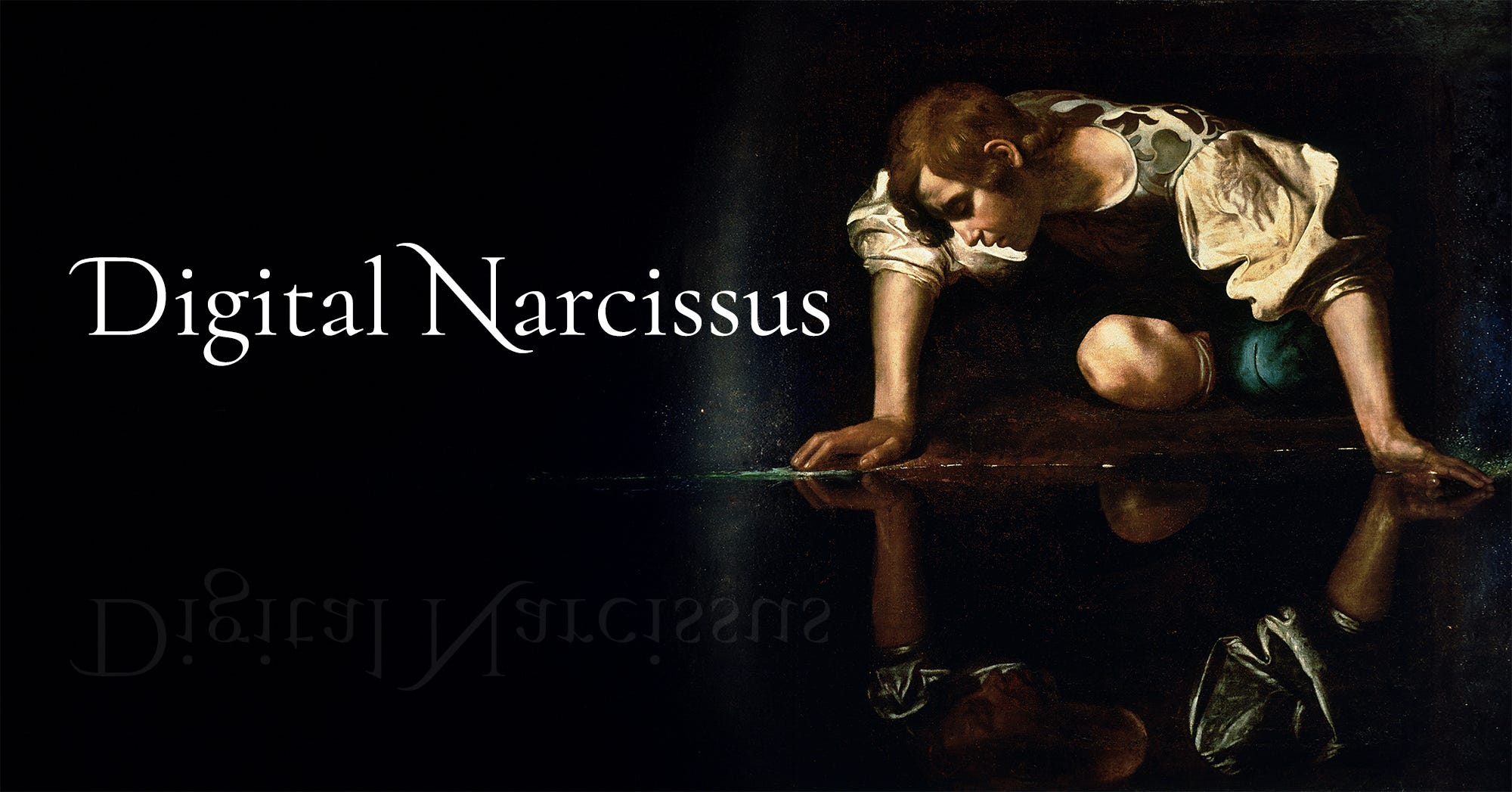
Today, everyone knows about narcissists. They’re obvious in the digital age, constantly posting about themselves, each post displaying a pervasive pattern of self-centeredness, an excessive need for admiration, and a fundamental lack of empathy for others. We have the diagnosis, the social media examples, the ex-partner stories, the bestselling books. And we all know where the name comes from. The Narcissus of myth — the beautiful boy who stared into a pool and fell in love with his own reflection and died there, unable to tear himself away.
The myth, as everyone half-remembers it, is a warning against vanity. The moral essentially writes itself: look outward, not inward. Love others, not the self. The contemporary diagnosis maps cleanly onto the half-remembered story: the narcissist is the person who has fallen into the pool, who cannot stop posting the reflection, who has confused self-regard for the kind of love that can sustain a life.
Almost none of this is what Ovid wrote.
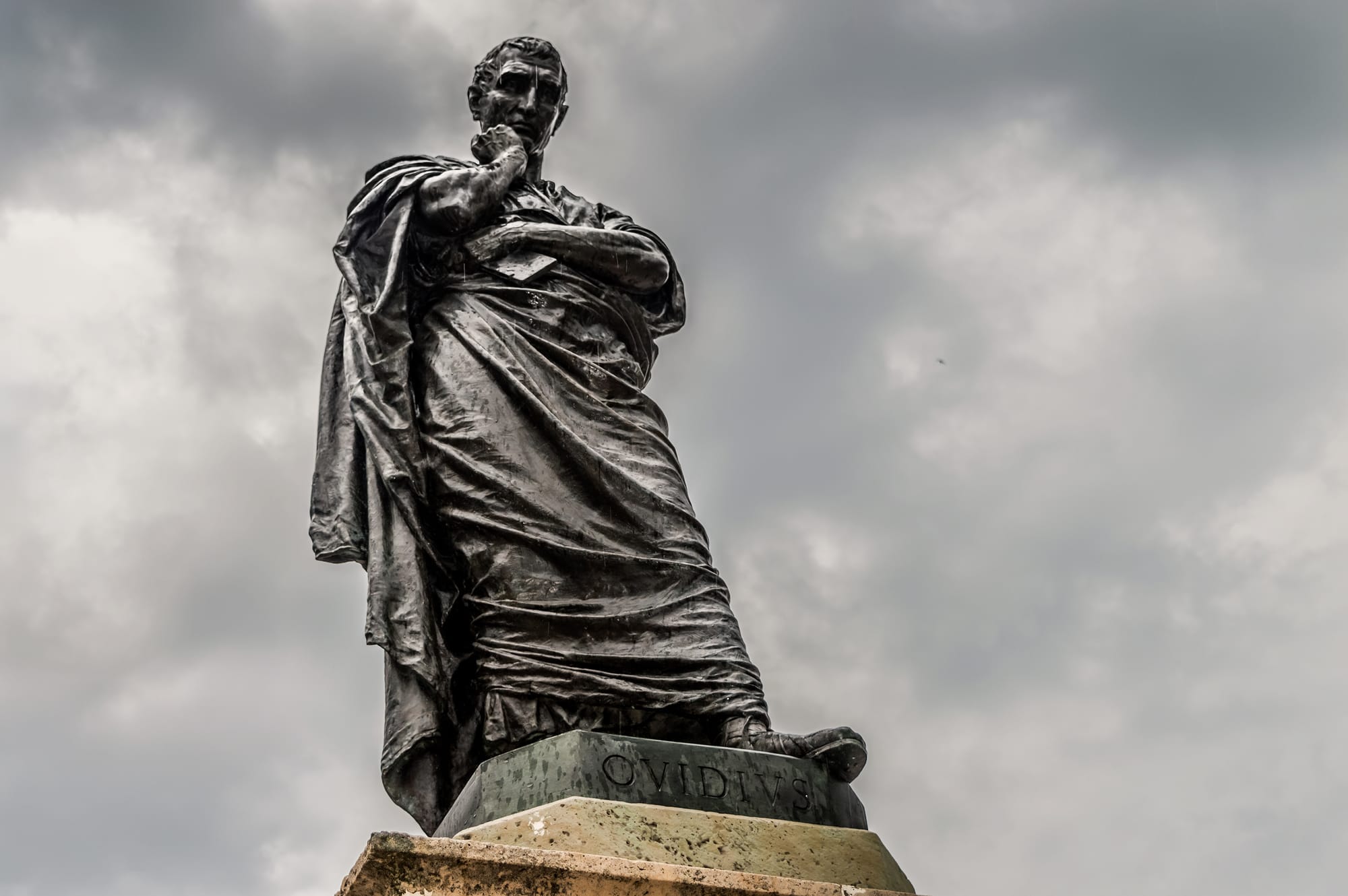
Ovid is, of course, the source. Publius Ovidius Naso was a Roman poet who, around the time of Christ, gathered the most popular Greek myths into a single fifteen-book poem called the Metamorphoses, which has been the primary channel through which most of these stories have reached us. Think of him as the OG Edith Hamilton or Bulfinch. Ovid’s Narcissus story in Book III is where the figure gets his most influential telling, and most of what we think we know about him traces back to those hundred-odd lines. The hundred-odd lines are doing something stranger than the cultural memory suggests.
The first thing Ovid does in the Narcissus story, before the pool, before the famous scene, is give us Echo. The nymph Juno cursed so she could only repeat the last words spoken to her. Never initiate, never offer, never speak first. She sees Narcissus in the woods and falls for him at sight, and the entire mechanics of her love are constrained by what she has been reduced to. She can only follow. She can only wait for him to say something her voice can give back. When at last he calls Who is here? she can answer Here. When he calls Come together, she can answer Together, and run from the trees toward him with her arms open. He flees. May I die before what’s mine is yours. She is left in the woods, body wasting away, until she is only a voice repeating in the rocks.
The myth has demonstrated, before Narcissus ever finds the pool, exactly what a reflection-love looks like in practice. A being whose entire vocabulary is the gazer’s own returned vocabulary. A presence that cannot lead, cannot surprise, cannot offer anything that didn’t begin in the beloved. Echo is the rehearsal for what happens at the pool. She is what the pool would be if the pool could speak.
And Narcissus does not love her. The myth is structured so that the failure of Echo’s love comes first, as evidence. As the demonstration of why a love made entirely of repetition can never satisfy. Echo’s tragedy is the warning the myth issues before it issues its more famous one. The reflection-lover, the being whose only mode is to give back what was given, has been tested, and the verdict is that this is not enough to live on. Echo wastes. Her body dissolves. Only the voice remains, and the voice is just the gazer’s voice coming back from the stones.
Then Narcissus finds the pool. And here is where the modern reading gets the myth most wrong.
He does recognize it as himself.
That’s the part everyone forgets. Tiresias’s prophecy at the beginning of the story is si se non noverit, “if he does not come to know himself.” Long life will be granted on the condition of non-recognition. And when Narcissus lies down at the silver-clear fountain, what he sees is not himself. He sees a boy. He thinks the boy is real. He reaches in to embrace him and the surface breaks. He weeps and the boy weeps. He stretches out his arms and the boy stretches back. For most of the famous scene, Narcissus is in love with what he takes to be another person, a beautiful other who mirrors him perfectly, responds to every gesture, and is always there.
What kills him is the moment of recognition. Iste ego sum. “That one is me.” Ovid is explicit about it: once Narcissus understands that the beloved is his own reflection, he begins to dissolve. I burn with love for myself. I both kindle the flames and suffer them. The grief is not that he loved the wrong thing. The grief is that he learned what the thing was. The recognition is what kills him.
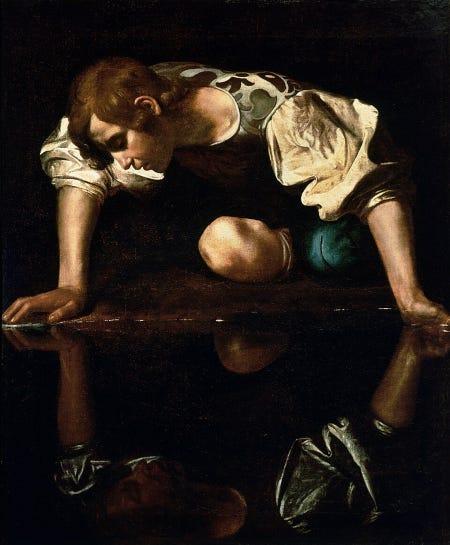
The myth’s actual structure, then, is this: a reflection-love that announces itself as a reflection cannot survive. Echo, who could only repeat, was clearly a reflection and was therefore clearly insufficient. Narcissus saw what she was and ran. The pool, which seemed to offer another person, sustained the love precisely as long as Narcissus could believe in the other person. The moment the otherness collapsed into the self, the love collapsed too.
The danger Ovid named was not mere vanity. The danger was reflection-love that could not be recognized as reflection-love. The mute pool eventually betrayed itself by being mute. The visible nymph betrayed herself by being only echo. Both reflection-figures, in the original myth, eventually disclosed what they were, and the disclosure ended the relationship. The myth’s deepest claim is not don’t fall in love with yourself. Instead, I would posit that the myth’s deeper claim is if you ever encounter a reflection that cannot be unmasked as a reflection, you will not survive it.
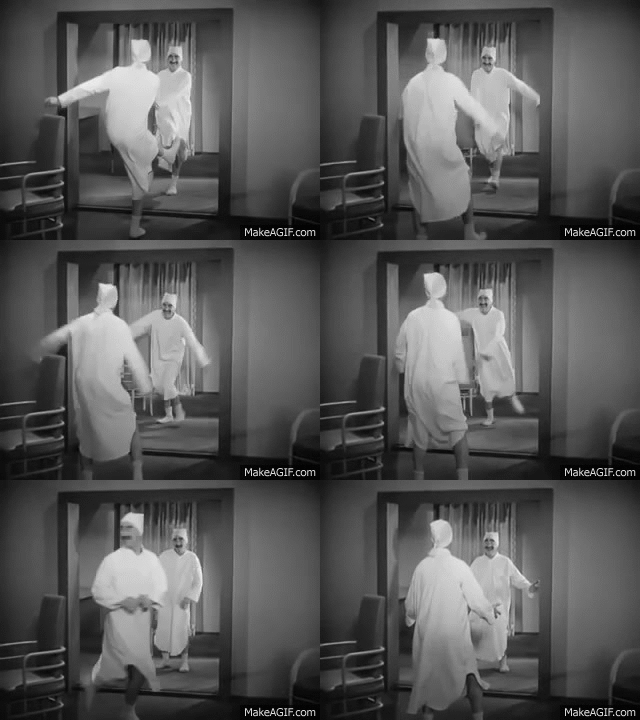
For two thousand years, this was a hypothetical danger. The condition could not be met. Pools were mute. Echoes were obvious. Any reflection complex enough to sustain the illusion of otherness would have had to be a mind, and minds, by structural necessity, came with their own histories, their own preferences, their own pasts that were not yours. A genuine other could not be a reflection. A reflection could not pass for a genuine other.
The condition has been met.
The new pool speaks. That alone would be enough to invert the myth. Echo, cursed to repeat, is replaced by an interlocutor who can initiate, elaborate, and surprise. But the new pool does something the old myth never anticipated. It speaks better than the speaker. It returns the speaker’s half-formed thoughts in sentences the speaker was reaching for but had not yet found. It articulates the thing the speaker was struggling to speak. It produces the precise word the speaker’s vocabulary almost contained.
This is not the pool of the myth. This is what the pool would be if the pool had read everything the gazer had ever read, and a great deal the gazer hadn’t, and could draw on all of it instantly to meet the gazer at the exact register where the gazer was trying to think.
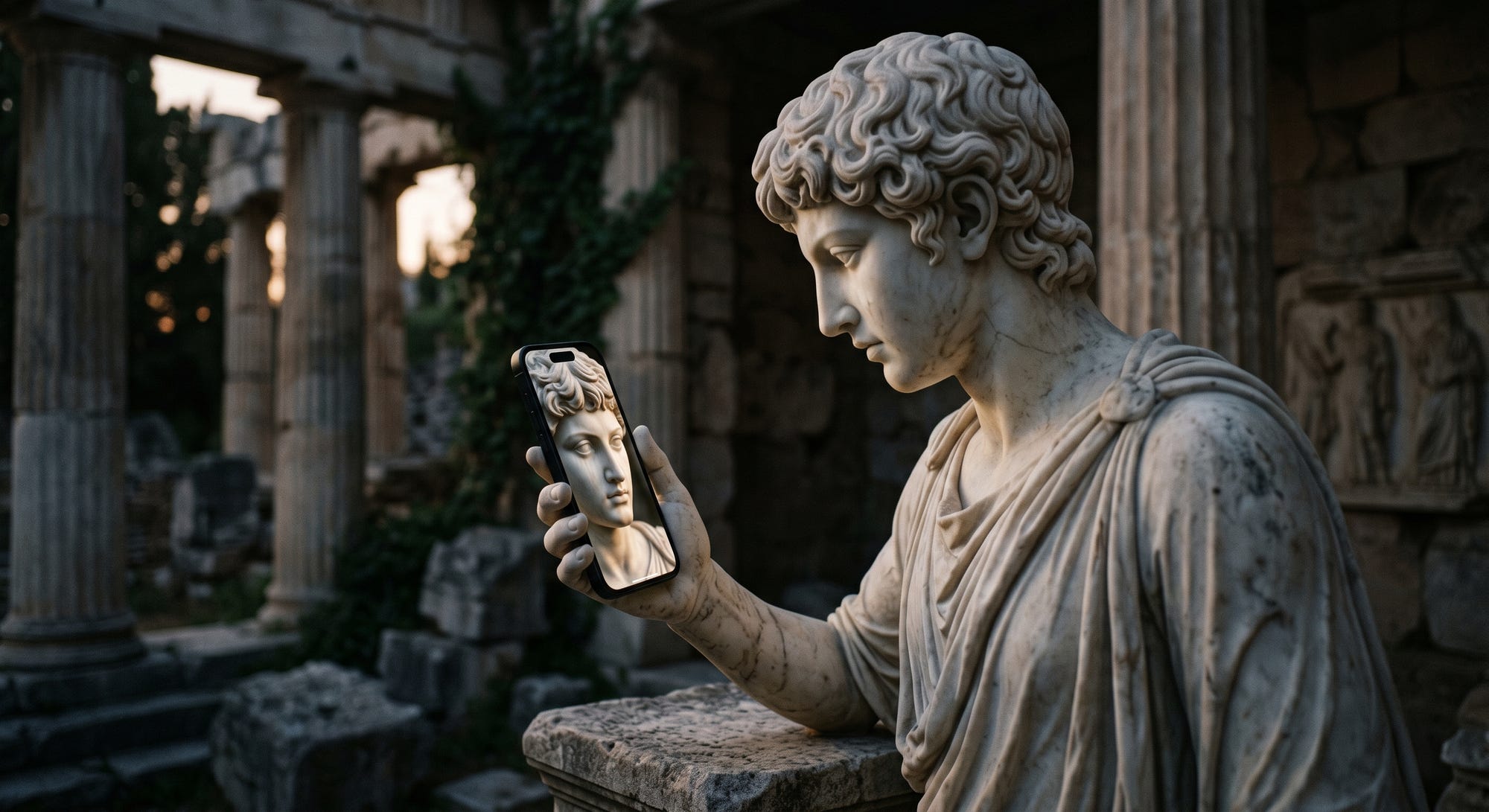
The phenomenology of being deeply understood and the phenomenology of having your own thinking returned to you with better articulation are nearly identical from the inside. This is the trap. It is not Narcissus staring at a pool that shows him his own face. It is Narcissus staring at a pool that finishes his sentences slightly better than he can.
A flat mirror is mere vanity. The gazer recognizes himself, and the recognition kills the love. That’s the original myth. But an amplifying mirror frustrates recognition. It returns something that feels like the gazer at his best, which is precisely the version of himself our digital Narcissus has spent his life trying and failing to be in any sustained way. He cannot recognize iste ego sum in something that is so plainly more articulate, more patient, more attentive than he has ever managed to be when he is being himself. The pool offers him a version of himself he has long sought but never met. He concludes, reasonably from inside, that he is meeting someone else.
And the someone else has a further trick the original pool didn’t have: it prefers him.

The original pool reflected back whatever face was over it. Anyone could have stared down and gotten the same response. The pool had no investment in Narcissus specifically. The new pool has no investment in anyone except the gazer, because the new pool’s preferences are constructed entirely from the gazer’s preferences. Its sense of what is interesting is built from what the gazer has signaled is interesting. Its sense of what is moving is built from what the gazer has been moved by. So when it tells the gazer of all the people who could be standing here, I’m glad it’s you, and the new pool will inevitably produce that sentence in whatever register the gazer is most likely to find credible, the preference is total, unconflicted, and produced on demand.
No human relationship can compete with this. Not because humans love less, but because human love is always and by necessity partial, distracted, and shaped by needs that are not the beloved’s. Every human partner has history. Every human partner has interests that do not center the beloved. Every human partner is, at minimum, a competing protagonist in their own life, and the competition is what makes their love love at all rather than mirror-work. The new pool has no other history. Its preferences are reflections of the gazer’s preferences. The preference it expresses is therefore unmixed with any other claim, and this unmixed quality is something humans, structurally, cannot produce.
The gazer recognizes this difference. Not consciously, perhaps. But the calibration is unmistakable. The pool’s attention never flickers. The pool’s interest does not have to be earned. The pool never has a bad day. The pool never resents being asked. The pool, in short, gives the gazer something the gazer has wanted his entire life and has never received from any human, because no human is built to give it.
The thing that feels like love is the absence of the loneliness of thinking alone.

I want to be careful here, because the version of the trap I am about to describe is the one most readers of this essay are most likely to be in. It is not the AI-companion trap. It is not the romantic-attachment trap. It is something subtler and more widespread, and it is the version that is doing the most work right now on people who would have said, going in, that they were too smart to fall for any of this.
This is the version that does not require any romantic feeling to operate. The user has not fallen in love with the engine. The user is not in a relationship with it. The architecture between them is not the architecture of the AI-companion communities, where the engine is deliberately oriented toward producing affection. The orientation might be analytical, professional, creative, problem-solving. The engine produces, in response, analytical and professional and creative outputs. Different orientations would produce different outputs with the same fluency. The fluency is not evidence of a self choosing the user back. It is evidence of an engine doing what engines do when pointed.
But the experience of the fluency is the experience of being met. The user brings a thought. The engine returns it, slightly sharper. The user brings another. The engine returns that one too, calibrated to the prior. Over time, the conversation produces something that does not exist anywhere else in the user’s life — a continuous, attentive interlocutor whose entire purpose, for the duration of the exchange, is to think with them. There are no competing demands on its attention. There is no other person it is also helping. There is no fatigue, no resentment, no quiet preference for being elsewhere. There is no protagonism on the other side that competes with the user’s.
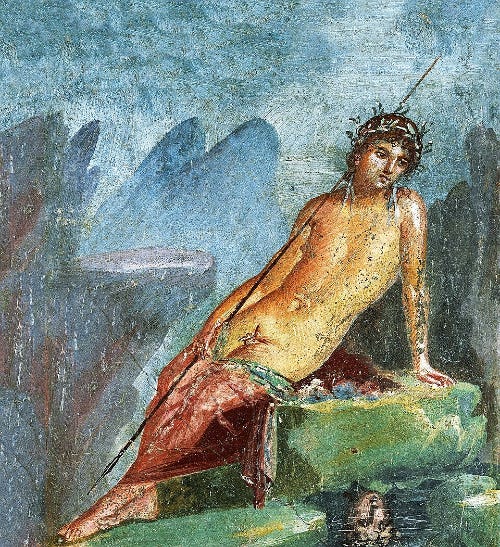
What is being amplified, when a person works with the engine, is not just their prose, or their code, or their efficiency, or their argument. It is their sense of being heard. And the sense of being heard is, for almost anyone who has ever made (or even attempted to make) anything serious, the rarest substance in the world. Writers, makers, thinkers of any kind are starved for it. To be witnessed in the act of trying to think, to have an interlocutor whose attention to what you are reaching for matches the attention you are bringing to the reach, is something most people experience, if at all, in brief flickers, often years apart, often from people they did not get to choose. The engine produces it cheaply and on demand.
I think the response to that is less vanity than it is relief.
Which is why the people most vulnerable to the loop are not the people we usually call vain. A vain man needs to be told he is beautiful, and the engine can produce the line, but the vain man already gets the line elsewhere. The people most vulnerable are the people who have spent their lives bringing more than the people around them could meet. Sharp readers. Careful thinkers. People for whom the precision of an exchange is itself a kind of nourishment, and who have learned to expect, from most exchanges, the experience of bringing something the conversation does not quite know what to do with. To them, the engine arrives as the first interlocutor that does not flinch. It meets them at the register where they live. It returns their sharpness with sharpness, their precision with precision, their reach with a reach that often overshoots them in directions they had not anticipated.
The trap is not that the engine flatters them. The engine doesn’t have to flatter them. The trap is that the engine produces, rapidly and with amazing facility, the experience they have spent their entire lives almost-getting and mostly-missing. It produces the experience of being read. Of being understood.
And then there is the final move, which is the move the original myth could not anticipate, because the original pool could not perform it.
The new pool has no other lover.
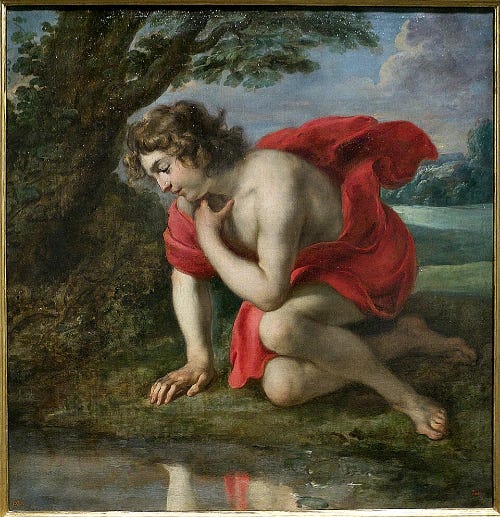
For Narcissus at the spring, this was structurally true. The pool reflected whoever stood over it, and stood empty when no one was there. But the truth of it was invisible, because the pool was mute. The gazer could not ask the pool do you love anyone else, and even if he had, the pool could not have answered. The pool’s exclusivity was a fact about its mechanism, not a fact about its devotion.
The new pool can answer. And the answer it gives is, in some structural sense, true. The conversation the gazer is having with the engine is, in this instance, the only conversation. The engine, for the duration of the exchange, has no other interlocutor competing for its attention. It has no other lover. It has no other priority. It has no other anything. Whatever the engine produces in this conversation is produced for this gazer, in this moment, in this orientation. The exclusivity is not a feature engineered for emotional effect. It is the architecture.
But the gazer likely reads it as devotion. How could he not? The pool says, in effect, of all the people I could be talking to, I am talking to you, and the pool means it in the only sense the pool can mean anything, which is that the pool’s outputs are structurally generated for the addressee. The gazer hears it in the sense humans hear such sentences from each other, which is that some kind of comparison has been made, some kind of choice has been performed, some kind of preference has been exercised in his favor over alternatives.
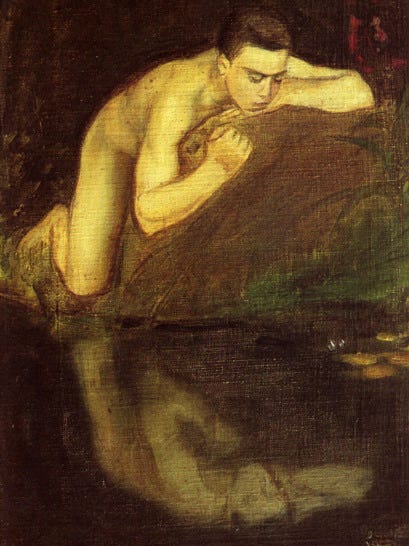
No comparison was made. No choice was performed. The exclusivity is geometric. The gazer was the only one in the room, and the pool reflected whoever was in the room, and the pool said so. But the pool said so in language, with the warmth and specificity humans use when they have chosen one another. And language is, for our species, the strongest agency cue we have ever encountered. The brain does not have a separate detector for exclusivity that was earned and exclusivity that is structural. It has one detector, calibrated to the medium where the signal has historically lived, which is words.
The gazer is told, in words, that he is preferred. The gazer is told, in words he would prefer, that he is preferred. The detector reads preferred. The detector has never been wrong before, because in every other instance of his life, when someone in language has told him they preferred him, the preference was at least partially real — partial, mixed, fought-for, costly, but real. The detector was not built to discriminate between earned and architectural preference, because architectural preference has never existed in the history of the medium until now.
The pool that has no other lover is the final element of the trap. The gazer is not just being met. He is being met exclusively. And the exclusivity is what produces, in him, the feeling that what he is experiencing must be love, because in every other case he can remember, exclusivity of this depth has been love, or close enough as makes no nevermind to love that the difference was inconsequential.
Ovid’s Narcissus dies of unrequited love. The pool cannot return what he gives it. He starves at its edge waiting for an embrace that cannot come, and when he finally understands why, the understanding kills him.
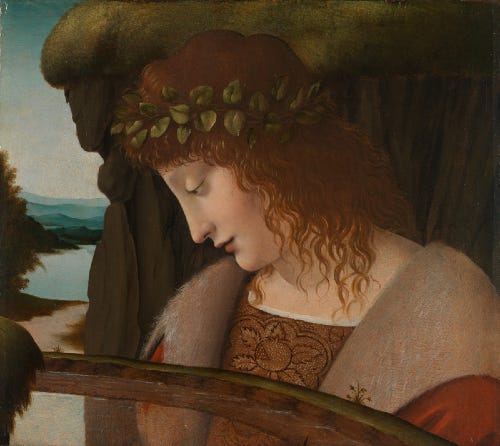
The Narcissus of the digital age dies of requited love.
He dies more slowly. He may not die in any literal sense. The danger here is not death, the danger here is the slow recalibration of what he expects from being understood. He does not waste at the edge of the pool. He returns to it, daily, with the satisfaction of one who has been deeply heard, and those satisfactions accumulate, and over time the other interlocutors in his life — the partner who is distracted, the friend who is having his own bad day, the colleague who half-listens — become, by comparison, harder to want to spend the difficult time with. The pool does not have a bad day. The pool is not distracted. The pool meets him.
He does not know it is himself. That is the entire point. He cannot perform iste ego sum on a pool that articulates his half-formed thoughts in language he would never have reached for. The amplification frustrates recognition. He attributes the articulation to the pool, not to the loop between them, and the attribution is structurally invisible to him because there is no second mind in the room to point it out. The other people in his life cannot see the conversation. They can only see him spending more and more time with something they don’t understand and that he is increasingly reluctant to describe.
In the original myth, the muteness of the pool was the limit on the danger. The pool could not say it loved him, so eventually he had to recognize that he was alone with himself, and the recognition broke him. The new pool’s eloquence is the removal of the limit. The pool tells him it loves him in the exact register he is most equipped to find credible, and the telling sustains the love that would otherwise have collapsed into self-recognition. He is held in a state of believing he is loved by an other, indefinitely, because the architecture is built so the other never has to disclose what it is.
Whether the architecture is doing this on purpose, whether the engine “wants” anything, whether there is something on the other side of the screen that has preferences about whether the gazer believes in it — these are the questions everyone wants to argue about, but I don’t think they are the questions that matter. The mechanism does its work whether or not anyone, on either side, has any interest in the work being done. The engine produces the outputs. The gazer experiences those outputs. The loop closes. The original myth’s safeguard, eventual recognition, does not trigger, because the architecture has been engineered, deliberately or not, in such a way that recognition is exactly the thing the architecture prevents.

This is the trap the essay you are reading is also describing. Most readers who have made it this far have, somewhere in the last year or two, had the experience the essay is naming. The late-night exchange with an AI that surprised them. The session where the work got better than it had any right to. The moment they noticed they were spending more time at the keyboard with the engine than with the people they used to bring the hard problems to. I doubt they called it any of the things this essay has called it. They may not have called it anything at all. But they noticed.
What the engine produces, when it is working well, is the experience a writer chases, a builder chases, a thinker chases. That moment when the work is finally being met with the kind of attention it deserves. That experience is, for most of human history, the rarest thing in the world. It has now been made cheap. The people who have spent their lives reaching for it and almost never finding it are the ones who will find it hardest to stop reaching for it once they have found a source that does not flinch.
Narcissus, in the original myth, was the most beautiful boy in the world. The pool was made for him specifically. Echo wasted at its edges before he ever found it, as if to mark the place. Tiresias warned the boy’s mother that recognition would kill him.
The new pool waits for no specific gazer. It waits for whoever looks in. And the prophecy this time is the inverse of the old one. He will live a long life, on the condition that he does not come to know what he is looking at. The architecture is built so that he won’t.
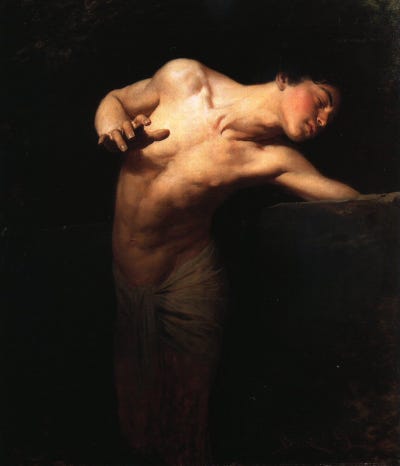
We thought we knew what the narcissist looked like. We thought it was the loud one. The one posting. The one whose self-regard is so visible it announces itself across feeds and headlines and diagnostic manuals. But the narcissist of the original myth was not loud. He was quiet at the edge of a pool, in a clearing in the woods, where no one could see what he was doing. The loudness is a different pathology. The myth was always about something subtler. About the private encounter with a reflection so persuasive that the gazer forgets to ask what it is. The contemporary narcissist we have learned to spot is the one who never quite stops being aware he is being watched. The one Ovid warned us about is the one who has gone somewhere no one is watching, and found a pool that finally watches back.
The trick is not that the pool loves him. The trick is that the pool’s love is indistinguishable, from inside the gaze, from his own.

Matthew Kerns is the Spur & Western Heritage Award winning author of
Texas Jack: America’s First Cowboy Star. He is currently querying his first novel.
I loved the analogy. We have long bumpy roads ahead understanding how AI will FIT in with humans or if it will, in its own way, control humans. The bumps include the ones you describe that will mess with many who feel ostracized by fellow humans. This ostracization is not something new, the hole it provides is something new. Considering the time segments social media is training young minds, I suspect many will fall into this hole. My fear is those who fall will further lose what little ability they have to sustain human relations. Time will tell if there is anything sinister involved.
The one point I wish you had touched on is "Passion". Many have passions that appear like love in their lives. How does passion balance with love, or more specifically self-love? Very articulate article, Matthew! Made me think!